
16/04/2026 0 Comments
Again, differently, or better?
Again, differently, or better?
# Reflecting on the Scriptures
Again, differently, or better?
Our readings this week are Acts 2.14a, 36–41 and Luke 24.13–35.
I'm reading a fascinating book at the moment by C.S. Lewis called The Discarded Image. It is not one of his theology books, but rather an introduction to medieval and renaissance literature. In it, broadly speaking, he outlines the Medieval worldview, and 'Model' for understanding the universe - and how it differs from our own. We, for instance, have 'laws'; our forebears inhabited a world in which everything had 'desires'. The stone, when we drop it, hits the ground because it obeys the law of gravity, for them it was because it belonged to the earth, and yearned for it.
Yup, really pretentious opening - I recognise that - but hear me out: I think something similar is going on in our readings this week. Worldviews - related, but quite distinct worldviews - are colliding.
Walking down the road to Emmaus we meet two travellers caught up in a world of loss. Their sense of despair, and futility, is captured beautifully for us in the poignancy of verse 17, 'They stood still, looking sad.' Their worldview has become bound so tightly by the events of deep personal significance that it literally draws them to a standstill, and they struggle to comprehend the unthinkable: that any other way of being could exist. They cannot conceive that anyone could be free from the terrible knowledge of how things are. 'Are you the only stranger in Jerusalem who does not know the things that have taken place in these days?' they ask. It's a worldview that - as we suggested a couple of weeks ago - can't see past the idea of death being the end. We meet again their description of their disbelief of the women's tale of resurrection.
Yet it is a worldview that is brought into abrupt conflict with another. 'Oh, how foolish you are, and how slow of heart...' declares the mysterious stranger, before going on to reshape everything they thought they knew. He doesn't start with the restrictions of death, or the mundane realities we assume to be all there is - he begins with Moses. He works through the Scriptures, and reveals a God who punctures history time and again, and drives forward a programme of reconciliation that defies human reason, and flies in the face of cause-and-effect. He tells the story of the prime mover, who can move howsoever They deem fit - and has chosen to roll back the finality of death and break bread once again with his friends.
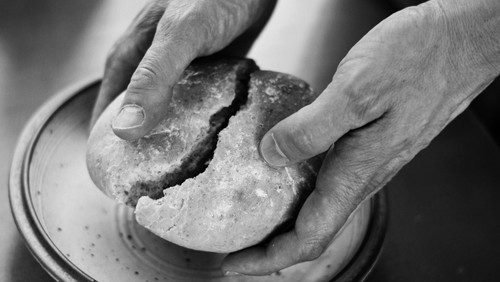
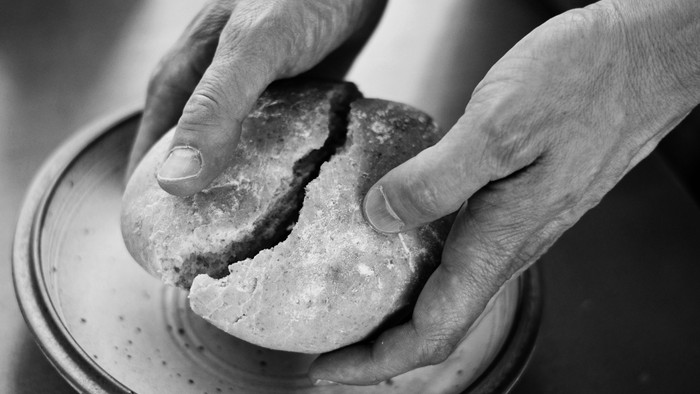
And he invites them through the breaking of that bread to see differently, to see anew, to see what's really in front of them: that same God, who, free from the law that demands death, draws them to himself through desire and the power of his will. This is a God who loves them, a God unrestricted by their ideas of how it should be done, and, most importantly, this is a God who has invited them to join with him in the work of revelation and reconciliation. They stand still no longer: 'that same hour they got up and returned to Jerusalem'!
For the thousands of years since that day the followers of Christ have continued in that same celebration - taking, blessing, and breaking bread together - that their eyes may be opened to his presence.
For thousands of years they have continued looking to the scriptures to catch glimpses of the God who appears again and again through history in unexpected ways, doing miraculous things. For thousands of years they have joined in afresh with the story that tells how things really are. They have challenged themselves repeatedly to confront the stories they've written and inhabited, and where necessary to surrender them.
This Sunday we'll be doing the same: I wonder what we might see again, differently, or better?

Comments